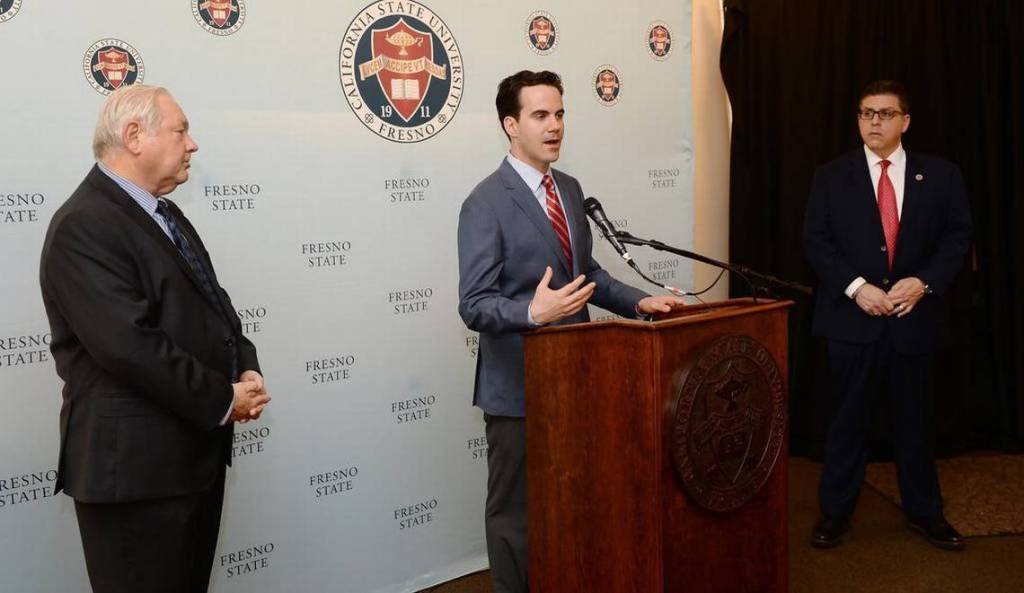
Washington Post national political reporter Robert Costa, who also hosts “Washington Week” on PBS, says the work that Fresno State’s Institute for Media and Public Trust is doing on media literacy is crucial in building trust in our institutions and creating a better-informed society.
Costa was in Fresno Nov. 27 as part of Fresno State President Joseph Castro’s lecture series. The Media Institute’s executive director, Jim Boren, moderated a 90-minute conversation with Costa during a public event at the Save Mart Center. The discussion mostly centered on President Trump and national politics, but also included questions about the media’s role in today’s highly charged political environment.
Trump has been highly critical of the media, and has labeled news reports that he doesn’t like as “fake news.” There is also a growing mistrust of media among many Americans. Their concern is often driven by partisanship, but public opinion polls show that the media skepticism is a significant challenge among a segment of the population.
The Institute’s mission is to improve media literacy, develop strategies to identify fake news and look for solutions to bridge the trust gap between media outlets and news consumers. The Institute also is working with the Fresno County Office of Education to develop a media literacy module for high school reading and composition students.
The Media Institute started in June with this announcement from Fresno State.
During a news conference just before Costa’s appearance, the journalist praised the Institute’s work.
“This county is built upon trust in its institutions, and those institutions include the press,” Costa said. “And to have people appreciate institutions like the press, they need to be taught about the press, they need to be reading and engaged, so to have an Institute here committed to having people be informed is critical – and that’s a nonpartisan point of view.
“If you believe in this country, if you believe in democracy, then you should believe in people being informed and knowing about the press, not as some kind of political thing, but as something that’s there to inform.”
The Media Institute’s work is guided by the First Amendment. We believe strongly that a well-informed citizenry will improve civic engagement and participation in our democracy.
We talk a lot about ethics, values and transparency as we look for solutions to the mistrust that is so prevalent today in all of our institutions. We will be seeking common ground as we look for ways to bridge the trust gap.
As we seek solutions, you will be hearing from traditional media and media outlets from across the political spectrum. Digital sites and social media will also be a big part of our work, as we attempt to take the broadest view of the issues that impact the news that the public consumes in the 21st century.


 Institute for Media and Public Trust at Fresno State
Leave a comment