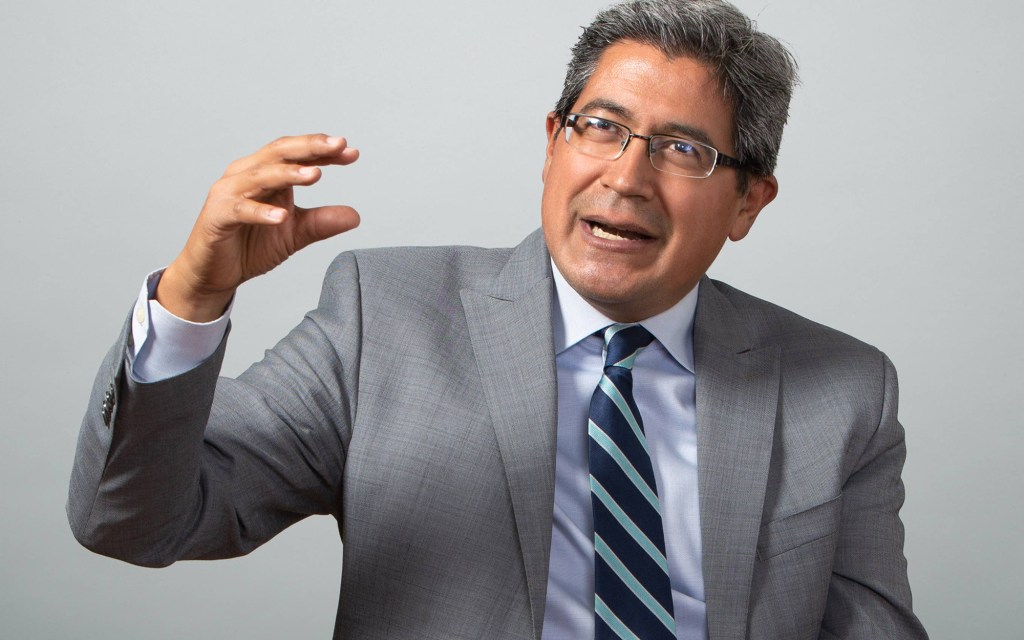
The story behind the New York Times reporting that challenged the public image of the iconic farm labor leader.
The New York Times exposé that brought down civil rights icon Cesar Chavez was always destined to be more than a mere investigative story. It’s a testament to the persistence of journalism and the courage of survivors who came forward.
Manny Fernandez, one of the two Times reporters on the March 18 story, faced countless moments when the sexual assault victims were not ready to speak. Yet he did not give up. He returned, always with respect. He asked, patiently and repeatedly, honoring their timing, their trauma, and their silence, until they were able to share their truths.
“There was a whole group of women who had been carrying this secret for decades,” Fernandez told KVPR’s Central Valley Daily. “It was eating them alive, and they were understandably reluctant to talk about it.”
Fernandez had been working on the story intermittently for five years. His persistence was never coercion. It was patience. Gradually, the women began to trust him, revealing the experiences that had haunted them for years, exposing a side of Chavez the public had never seen.
When the story finally reached print, its impact was nothing short of seismic. The reporting did more than surface allegations. It tore apart the carefully crafted image of a revered leader and sparked a national reckoning over how history remembers him. It was also a story for those who had been silenced for far too long.
Quickly, Chavez statues came down. A holiday named for him was renamed and streets with Chavez’s name on them were being reconsidered.
For Fernandez, this reporting was deeply personal. The farm labor movement started in his back yard in the San Joaquin Valley. He grew up in Fresno, attended San Joaquin Memorial High School where he wrote for the high school newspaper, and earned a journalism degree at Fresno State in 1997. He wrote for the Fresno State student newspaper, The Collegian, and interned for a time at The Fresno Bee during college.
Fernandez’s grandparents had been farmworkers, and the legend of Cesar Chavez was woven into his community and family history.
“Ana Murguia, one of the women in our story, told me in 2021 she wasn’t ready to talk and she didn’t want to talk,” Fernandez recalled in a podcast for KVPR. “Deborah Rojas, another woman in our story, also told me in 2021 that she didn’t want to talk.”
At the same time, Fernandez and his reporting partner, Sarah Hurtes, were investigating other aspects of Chávez’s relationships with these and other women. There was too much there to drop the story.
“And as we were hearing different accounts, talking to other people, and reviewing documents, it became clear that these two women did have a story to tell. It was worth going back to them respectfully, explaining that we were learning more about what happened. Eventually, they were ready, and they did want to talk.”
Fernandez is deeply devoted to journalism, believing in the power of stories that uncover important truths. His career path would take him to Fresno State where he starting thinking about where he wanted to land in journalism after graduation.
“When I was a student at Fresno State in the journalism program, I used to read the national pages of The New York Times,” he recalled.
He told himself that he wanted to do that someday. His first major newspaper job out of Fresno State was at the San Francisco Chronicle. Three years later, he was hired at the Washington Post. In 2005, he joined the New York Times. He is now California editor‑at‑large for the Times, which is a senior reporting and editorial role leading coverage in the region. In 2021, Fernandez was inducted into the Media, Communications and Journalism Hall of Fame at Fresno State.
“Sarah and I are just two reporters,” he said on the KVPR podcast. “It took a lot of time to get these women to share their experiences and then to corroborate what they were telling us. That’s how I see it. I believe journalism is a calling, and it matters. When done right, it can drive change.”
Still, despite all of their reporting, some ardent Chavez supporters refuse to believe the farm labor leader committed those horrific acts against young girls, while others question why such allegations only surfaced years after his death.
Fernandez acknowledged the skepticism some might feel but emphasized the evidence, corroborations, and documents revealed in the March 18 story. The facts were compelling, which is why numerous local and state leaders acted swiftly to dismantle Chavez’s legacy.
“After the story was published, I was talking to Debra Rojas, one of the women featured in it. She had been seeing the reactions on social media, people asking, ‘What’s their motivation? Why now?’ And Debra said something that has stayed with me. She said, ‘Why not now? When would be the perfect time for someone to finally come forward and tell their story for the first time?’
“I found that incredibly powerful, and it really stuck with me.”

 Institute for Media and Public Trust at Fresno State
Leave a comment